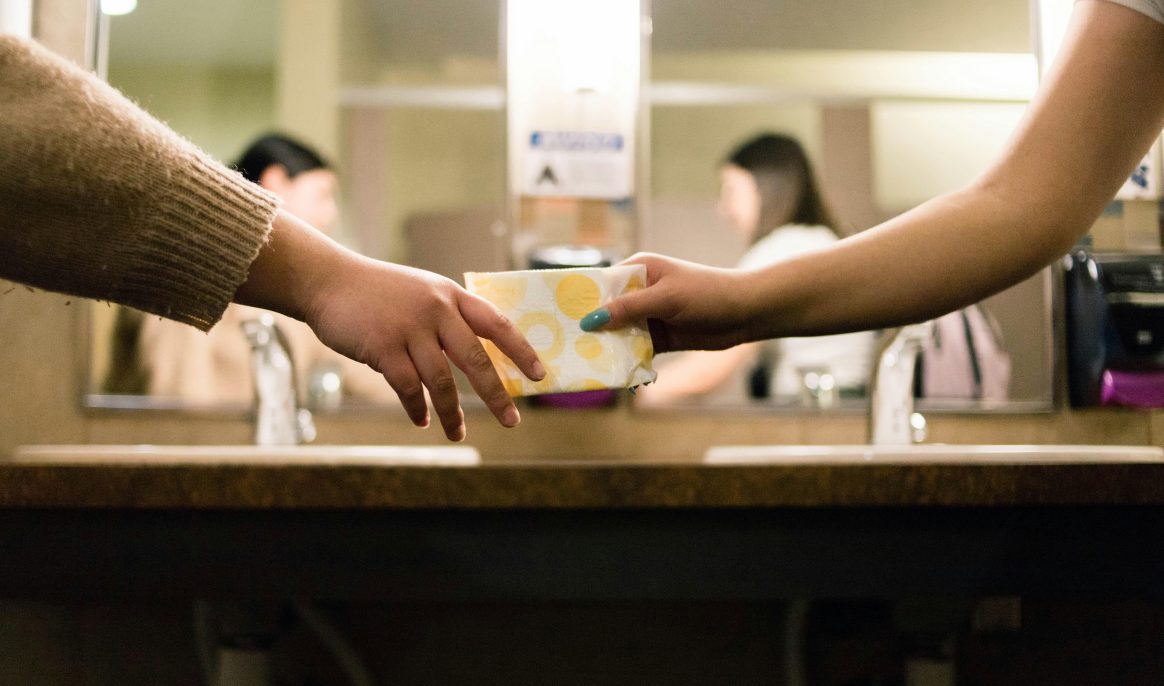
©Annika Gordon via Unsplash - photo d'illustration
-
May 30, 2026 15:11
Forced to use paper or scraps of cloth during their periods, many homeless women have no access to suitable protection. That's why Brazilian designer Rafaella de Bona Gonçalves has created biodegradable pads and tampons from banana tree residues, guaranteeing them dignity and the right to hygiene.
Breaking the silence surrounding menstrual precariousness by starting with homeless women: that's the idea that guided the work of young Brazilian designer Rafaella de Bona Gonçalves, who became internationally famous for her biodegradable pads and tampons (made from banana tree residues) designed primarily for women who live on the streets and have no access to basic hygiene products.
Her project was born at university, during a course devoted to the UN's Sustainable Development Goals. Initially, Rafaella de Bona Gonçalves had decided to study the different forms of poverty present in Brazilian cities. But it was her encounter with the homeless women of Curitiba that changed everything.
Talking to these women, the young designer discovered how menstruation can turn into a health, psychological and social problem in the absence of safe toilets, running water and menstrual protection. Many use pieces of cloth, paper or other makeshift materials, often in very precarious hygiene conditions. Others give up going out or looking for work during their periods. It's a little-told story, but one that's present in many cities around the world.
The "Maria" project for street women
It was from this awareness that "Maria" was born, a biodegradable sanitary tampon made from banana fibers, a material derived from the agricultural residues that abound in Brazil. The product has been specially designed to adapt to the living conditions of homeless women: no plastic, no complex applicators, no need for washing or sterilization. The format is reminiscent of a roll of toilet paper: the material can be detached, rolled up and shaped into different sizes according to each woman's needs. Attention to the most vulnerable people is at the heart of the whole project. Indeed, women living on the streets often don't even have the undergarments they need to use a conventional sanitary towel, nor suitable places to wash reusable menstrual cups.
That's why Rafaella de Bona Gonçalves has been working on practical, economical and accessible solutions, based on a direct understanding of real needs rather than a theoretical or commercial approach.
Eco-responsibility and social innovation
The project subsequently evolved into a range of multifunctional products: biodegradable towels that can be used both as external panty liners or transformed into tampons thanks to integrated perforations. The materials chosen (banana fibers, bamboo, cellulose and soy foam) also respond to another urgency: environmental urgency. Conventional menstrual protection contains large quantities of plastic and takes hundreds of years to degrade.
To finance free distribution to the most vulnerable, the Brazilian designer has also developed a "buy one, get one free" social model: each product purchased enables one to be given to someone who can't afford it.
Production involves women's cooperatives, which recover the plant fibers and offer employment to women in situations of great economic fragility, thus creating a chain that combines social inclusion, circular economy and fundamental rights.
International recognition
The project quickly attracted international attention. In 2022, the European Patent Office nominated Rafaella de Bona Gonçalves as a finalist for the Young Inventors Prize, recognizing the social and environmental significance of her innovation. However, for the designer, the challenge is not limited to creating a sustainable product. Above all, the aim is to make visible a form of inequality that is often ignored.
Menstrual insecurity affects hundreds of millions of people around the world every month, and concerns not only access to sanitary protection, but also dignity, health and the ability to participate in social life without stigma. In a world where menstruation remains a taboo, Rafaella de Bona Gonçalves' project demonstrates how design can become a tool for social justice. It reminds us that menstrual hygiene should not be a luxury, but a fundamental right.
Share: