
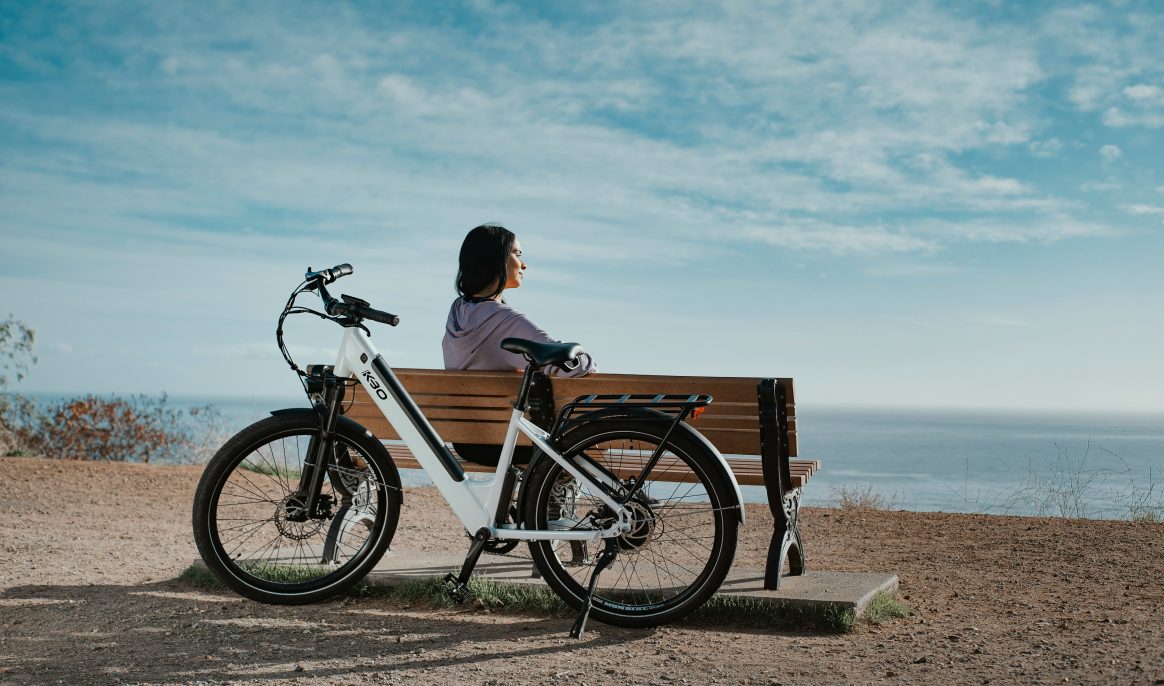
© KBO Bike via Unsplash
-
Jun 05, 2026 09:50
The rise of the electric-assist bicycle (EAB) has long been presented as good news for public health. But a recent Dutch study nuances this picture: depending on the mode chosen, the EAB can either bring you closer to WHO recommendations, or reduce your effort to the bare minimum.
A quarter of the effort in turbo mode
Researchers at the University of Twente finely measured the effort made on a VAE in the laboratory, on the track and in real-life conditions. Equipped with pedal power sensors, heart rate monitors and oxygen masks, the cyclists were able to quantify the energy actually expended according to assistance mode. The verdict: in turbo mode, the rider expends only around 25% of the energy required on a conventional bike, with a heart rate close to the resting level. In other words, the motor does almost all the work, to the extent that a quarter-hour of shopping can sometimes cost more energy than a quarter-hour on a VAE with maximum assistance.
Conversely, eco mode maintains a substantial physiological demand. According to the Dutch study, it represents between 70 and 77% of the effort of a traditional bicycle, a level close to that of a moderate-intensity activity as defined by the World Health Organization. Numerous studies have shown that repeated sessions at this intensity, even shorter than on a conventional bike, improve cardiovascular fitness and reduce the risk of premature mortality.
When the VAE replaces... the bicycle
In countries where there is little cycling, the balance sheet is rather positive: the VAE replaces the car or public transport, which mechanically increases the physical activity of users. But in the Netherlands, and increasingly in France, the electric bike is replacing the mechanical bike, especially for commuting. However, if you switch from a conventional bike to an e-bike used mainly in turbo mode, energy expenditure plummets, and you lose much of the health benefits of daily cycling.
This shift is all the more worrying given that sales of VAEs exceeded 800,000 units in France in 2024, testifying to their massive spread into everyday use. However, studies carried out in several European cities show that e-cyclists often ride further and more often, which partly compensates for the lower intensity of effort. The real challenge, then, is to guide users towards assistance settings that maximize this compromise between comfort, distance and physical effort.
Proper use
The question is not whether an electric bike is "good" or"bad" for your health, but how you use it. For children, who need intense and varied effort, the EAB brings few benefits and may even reduce their overall activity. On the other hand, for a high-school student covering 20km that he or she would otherwise do by car, or for a senior citizen who would no longer dare to take a conventional bike, assistance becomes a formidable lever against a sedentary lifestyle.
Researchers are advocating "assist as needed" systems, in which the motor only intervenes when riding uphill, into the wind or when the heart rate rises above a defined threshold, via a connected watch. A few top-of-the-range electric racing bikes are already experimenting with this principle, but they remain marginal on the consumer market. While we await the democratization of these technologies, our advice is simple: reserve turbo mode for really arduous situations, prefer eco mode for everyday use, and bear in mind that on an EAB, as elsewhere, maximum comfort is often paid for in fewer calories.
Share: