
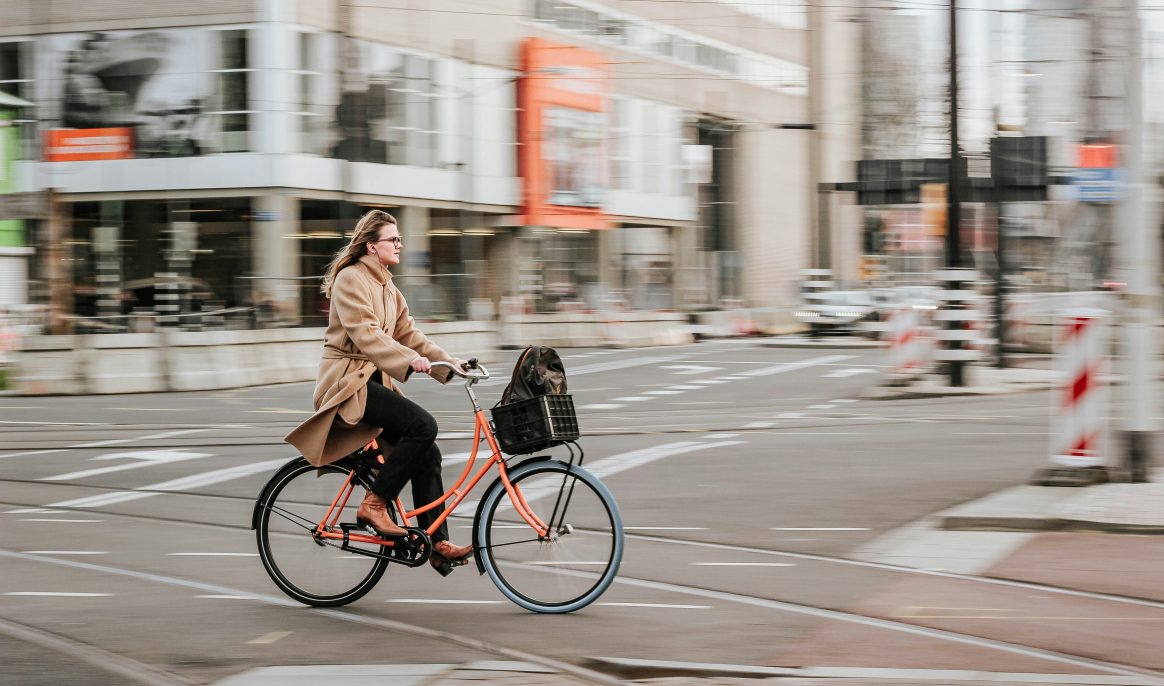
© Micheile Henderson via Unsplash
-
Jun 09, 2026 09:00
Velotaff, the practice of cycling to work, is becoming increasingly popular, but remains under-exploited. A recent OpinionWay survey of 834 French employees carried out for Lime illustrates this paradox: 89% recognize its benefits, but only 29% adopt it on a daily basis.
The term "vélotaff" is a contraction of"vélo" and"taf" (slang for"work"). It simply means commuting by bike. Introduced in the 2000s, the concept has evolved from a marginal practice into a true social phenomenon, with a growing community of urban "velotafeurs".
The French paradox: strong support, limited practice
The survey OpinionWay, (carried out for Lime among 834 employees in France) reveals a striking discrepancy. While almost nine out of ten employees perceive the benefits of cycling for work-related travel, almost 40% have never tried it. And yet, the context seems favorable: 75% of working people are discouraged by public transport (delays, overcrowding) and 69% denounce traffic jams and soaring fuel costs.
Above all, pragmatic motivations
Contrary to popular belief, it's not the environmental argument that dominates. For 55% of employees, velotaff represents first and foremost an opportunity to exercise without additional constraints. The financial argument comes in a close second at 51%, while ecological concerns mobilize only 40%.
Even more revealing: 71% see cycling as a way of "taking back control" of their commuting time. Feedback confirms this autonomy: 69% of cyclists arrive at work in a better frame of mind, and 68% use the return journey to unwind.
Real everyday obstacles
95% of employees identify at least one major obstacle: fickle weather tops the list for 46% of them, followed by the supposed length of the journey for 43%. However, perception and reality differ: 68% make a journey of less than 30 minutes, which would only be 7 minutes longer by bike. Fear of arriving sweaty (41%) and unsafe infrastructure (37%) complete the picture. On the latter point, 55% are calling for continuous, safe cycle paths, while 47% want better cohabitation with cars.
Intermodality and the role of employers
Intermodality is emerging as a solution: 62% of working people would be willing to bike if an electric bike were available to complement first/last-mile transport. This proportion rises to 72% among the under-35s.
Companies appear to be the key players: 27% consider them to be the most legitimate actors to encourage velotaffing, ahead of the State (16%) and town halls (14%). 72% would like an employer subsidy, via a mileage allowance (70%) or a combined reimbursement (69%). The Forfait Mobilités Durables (up to €800 a year) remains largely under-exploited. This optional financial scheme, set up by employers in France, aims to encourage employees to use more environmentally-friendly modes of transport for their home-to-work journeys.
Belgium and Switzerland: contrasting regional dynamics
In Belgium, the velotaff is booming, particularly in Flanders and Brussels, but its breakthrough is far less convincing in Wallonia. In 2024, 24% of work-related journeys were made by bike in Flanders (versus 21% in 2021), 9.4% in Brussels (7.2% in 2021), and just 3.3% in Wallonia (2.4% in 2021). Overall, 14% of Belgian workers cycle to work, but with major disparities: Flanders is 7 times more equipped than Wallonia. Brussels is showing positive growth of +2.2% since 2021. Local initiatives such as Vélotaf Belgique-Luxembourg (more than 10,000 visibility kits offered) and the Wapi project in Hainaut (shared bikes tested for 3 months) are supporting this transition.
In French-speaking Switzerland, velotaff is well represented with dedicated resources such as the cycliste.ch website, which in January 2025 published a guide entitled "Vélotaf : mode d'emploi" to help cyclists optimize their journeys. The approach seems more technical, with a focus on route optimization and practical support.
As you can see, while vélotaff embodies a more autonomous, healthy and economical form of mobility, it has yet to transform its acceptance in principle into widespread use. To achieve this, we need to overcome a number of practical obstacles: secure infrastructures, access to electric bikes and employer support. The trend is there, but there's still a long way to go...
Share: